
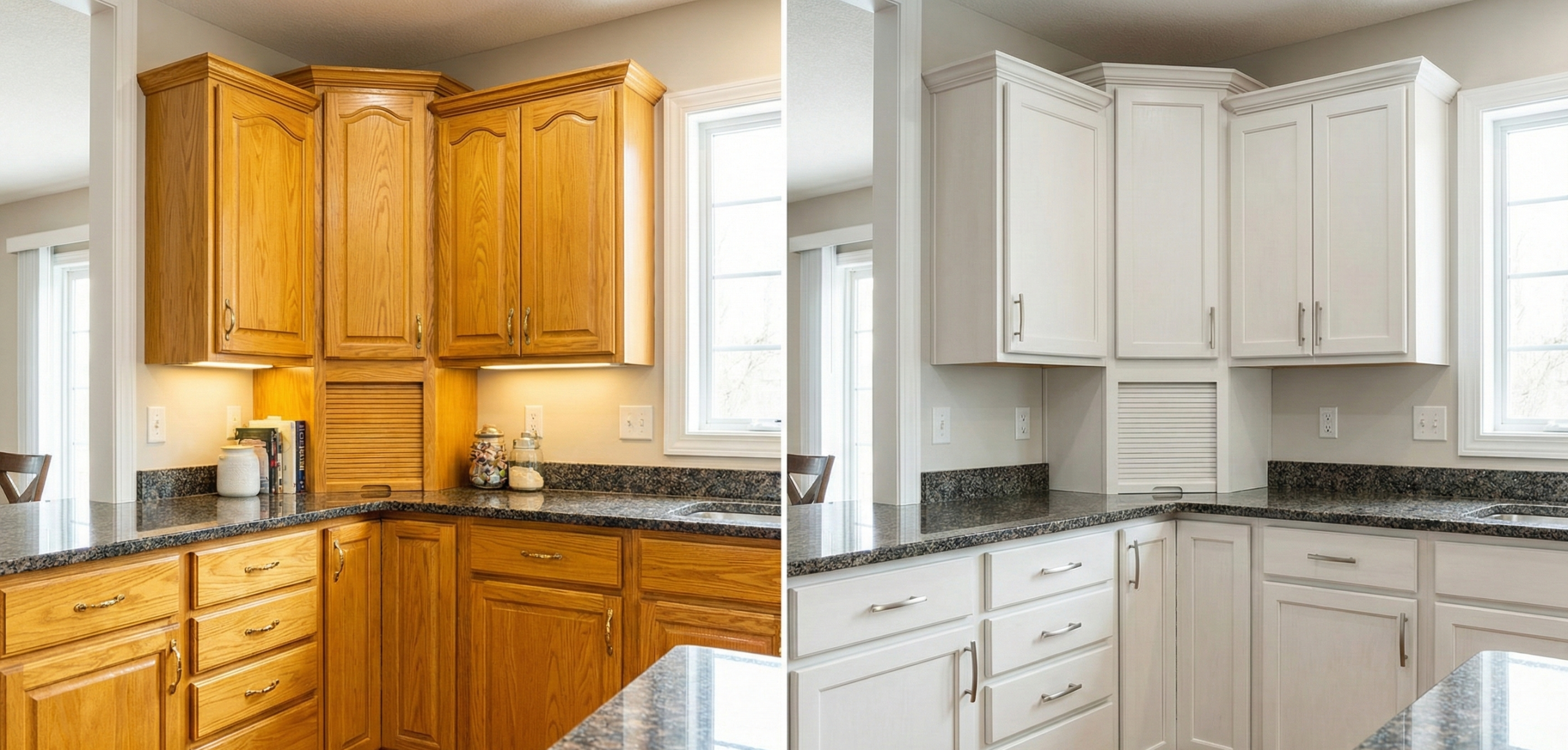
Someone called me sometime back about their 1998 oak cabinets. Before I could ask what she wanted to do with them, she told me about her countertops. They’re granite, installed in 2011, nothing wrong with them. Then she mentioned her backsplash, which she’d just redone last year. Then, almost as an afterthought, she said the cabinets make everything else look terrible.
This happens at least three times a week. The kitchen cabinet painting conversation starts with everything except the cabinets.
We’ve been coordinating these projects at Allen Brothers Cabinet Painting for a while now, handling the bids and scheduling for what’s become over 1,500+ kitchens across the Salt Lake area. The pattern is so consistent I could script it. People call about cabinets, but what they’re really asking is whether they have to rip apart a kitchen that’s functionally fine just to get rid of that golden oak finish they’ve hated since 2020.
Usually, they don’t.
The Kitchen Cabinet Refinishing Math Nobody Tells You
Here’s what that conversation looked like for the woman with the 2011 granite. Her contractor estimate for new cabinets came in at $23,000. Not installed. Not including the fact that new cabinet boxes have different dimensions than her 1998 originals, which means her granite countertops wouldn’t fit anymore. Add another $8,000 for new counters. And maybe another $1,200 for the backsplash she just paid for last year, now sitting on top of counters headed for the landfill.
We’re at $32,000 before anyone’s touched her appliances or flooring or the six weeks of cooking on a hot plate in her dining room.
Her kitchen cabinet painting bid was $6,200. That’s with the 2K polyurethane finish, which I’ll explain in a minute because it actually matters.
The interesting part isn’t the $26,000 difference. I mean, that’s interesting. But what stuck with me was what she said when I sent the bid. She didn’t say “wow, we’ll save so much money,” even though she will. She said “I just can’t face six weeks of contractors in my house right now.”
The money matters, obviously. But I’ve sent out enough bids to know the decision isn’t purely mathematical. It’s also about the granite that’s perfectly fine, the time your kitchen turns into a construction zone, and whether you want to explain to your family why you spent $30,000 on cabinets that held dishes just fine before.
Sometimes cabinet replacement makes sense. If your cabinet boxes are falling apart, or you’ve got water damage behind the sink, or you genuinely want to change the layout and add that corner Lazy Susan you’ve been dreaming about, painting won’t solve those problems. And I’ll tell you that upfront, because spending $6,000 on paint when you actually need new boxes isn’t saving money, it’s postponing the inevitable.
But if your boxes are solid, your layout works, and your main issue is that you’re tired of looking at honey oak every morning, the math shifts considerably.
What Actually Happens
The process isn’t complicated, but majority of people seem surprised by how it works. Partly because most painting projects involve someone showing up with rollers and spending a few weeks in your house. This is different.
We pull your cabinet doors and drawer fronts on a Monday morning, usually. They go to our shop in Centerville where they get sprayed with that 2K polyurethane I mentioned. While they’re gone, we spray your cabinet frames right there in your kitchen. The whole thing takes about a week start to finish, but your kitchen is only actually closed off for about three days during the spraying process.
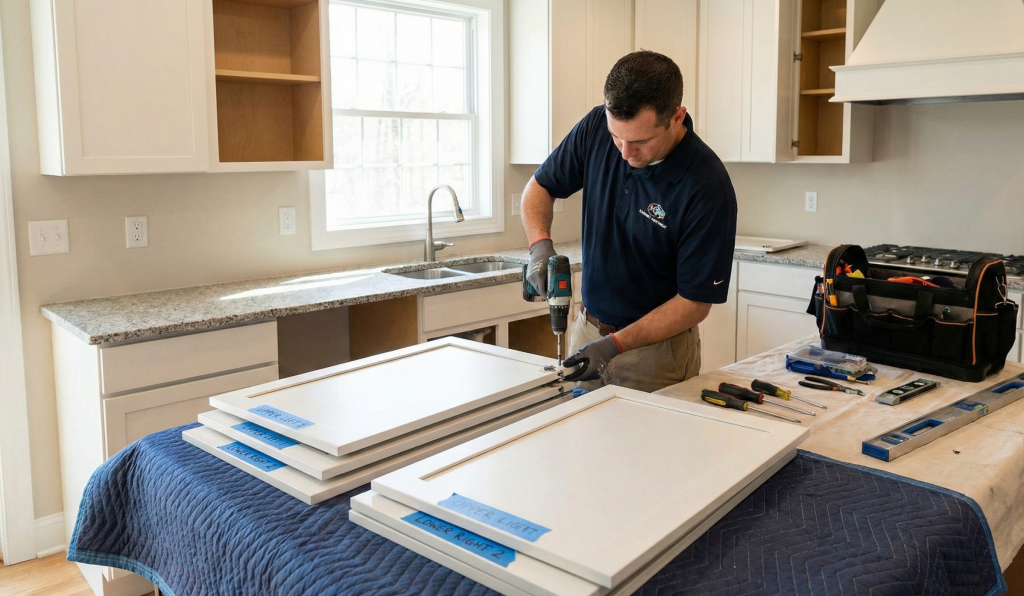
That 2K polyurethane deserves more explanation. It’s the same finish they use on airplane exteriors and high-end automotive work. It’s a two-part catalyzed coating, which means once it cures, you’ve got a finish that’s chemically resistant, moisture resistant, and considerably harder than the paint you’d pick up at Home Depot.
Most cabinet painters avoid it because it’s expensive and requires specific equipment and expertise. It’s easier to use standard cabinet paint and hope the customer doesn’t notice the difference. They notice eventually, usually when the finish around the handles starts wearing through after a couple years, but by then the painter’s moved on.
We use Milesi brand specifically. I’m not getting into a technical breakdown here, but the reason it matters is durability. That finish isn’t going to yellow over time like some traditional lacquers. It’s not going to chip off when you bump it with a pot. And it holds up to the kind of daily abuse a kitchen actually sees, which is considerable if you’re cooking for a family.
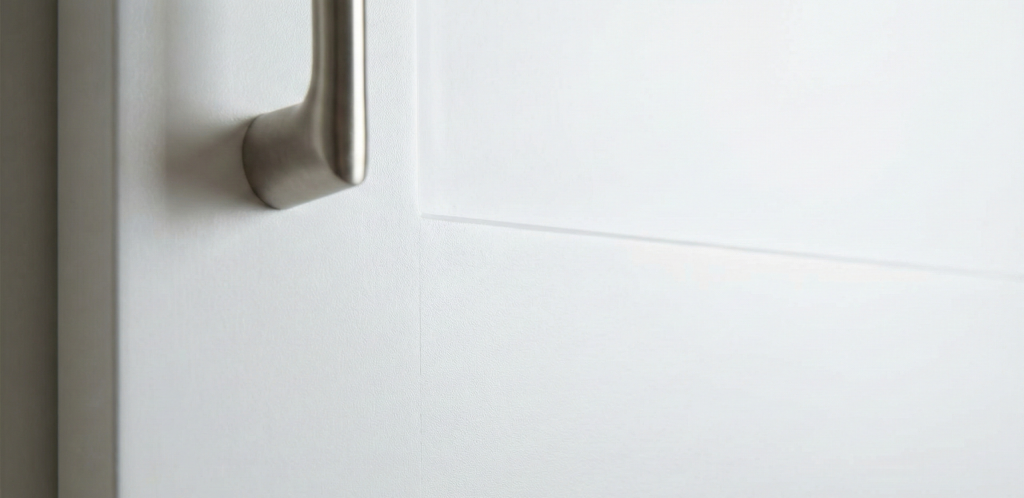
The low-sheen satin is what most people choose. It photographs well, hides minor imperfections better than high-gloss, and doesn’t show fingerprints the way a glossy finish does. Though some people want the high-gloss specifically because they like that modern, almost furniture-quality look.
People also ask about the three days when their kitchen is closed off. That’s real. We need ventilation for the spraying process, and you don’t want to be in there while we’re working. Most people set up a temporary kitchen situation in their dining room or garage. Coffee maker, microwave, paper plates. It’s not convenient, but it’s three days, not six weeks. And your countertops stay exactly where they are.
What It Actually Looks Like When It’s Done
You might not have seen a recently painted kitchen cabinet but let me tell you, when it comes to outstanding serive and professionalism, we are top notch. Just reading our reviews as they come in or from follow up calls once we have completed projects. The pattern in what they say afterward is pretty consistent
Someone had 1995 oak cabinets in Bluffdale, went with a soft white finish. Her review said the kitchen “looks like something from a magazine now, not like a bad paint job.” Another customer in South Jordan went with a dark charcoal gray on the lowers and white on the uppers. His comment was that people who visit ask when he got new cabinets, and he has to explain they’re the same boxes that were there when he bought the house in 2009.
That chemical resistance matters more than people think when they’re choosing finishes. One review specifically mentioned wiping down the cabinets after cooking and being impressed that nothing stained or damaged the finish. Another mentioned grandkids and sticky hands. The finish holds up to the actual use, not just the photoshoot version of a kitchen.
The durability isn’t theoretical. We’ve got reviews from people five years out saying the cabinets still look like we finished them last month. That’s the 2K polyurethane doing what it’s supposed to do.
There are limits to what painting can accomplish, and I’d rather be honest about them now than have someone disappointed later. If you want to change from raised panel doors to shaker style, painting doesn’t do that. You’d need new doors, which changes the cost significantly. If your cabinets are the cheap particleboard builder-grade boxes that are starting to sag, painting them just gives you painted sagging cabinets.
And if you want a drastically different layout, painting won’t add cabinets where there aren’t any or remove a weird corner that’s never worked. Those are structural changes that require more than finish work.
But for solid wood cabinets with a finish you hate and a layout that functions, painting changes the entire look of the kitchen for about a quarter of the replacement cost.
Making the Decision?
We’ve send out a lot of bids. Some come back accepted the same day. Some sit for weeks while people think about it. Some never come back at all, and I assume they went with replacement or a different painter or decided to live with the oak for another year.
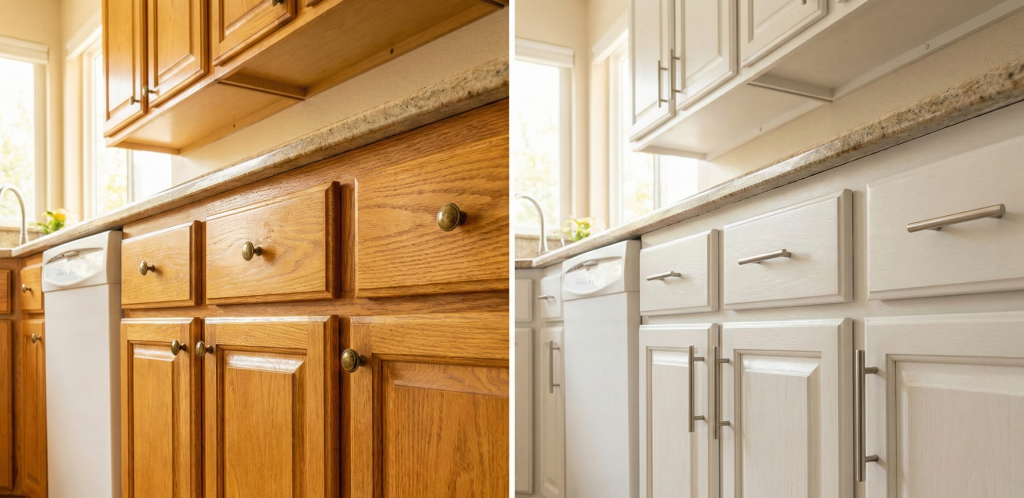
If I had to guess based on the conversations I have and the reviews I read, the people who are happiest with kitchen cabinet painting are the ones who wanted their kitchen to look different but didn’t want to change what actually worked. Their boxes are solid, their layout makes sense, their countertops are fine. They just couldn’t stand looking at golden oak anymore.
The people who sometimes wish they’d gone with full cabinet replacement are the ones who wanted to add an island or reconfigure the corner cabinets or change something structural that painting was never going to fix. That’s not a failure of the painting process, that’s a mismatch between what they needed and what painting can do.
Questions worth asking any cabinet painter, not just us: What finish do they use and why? How do they handle the frames versus the doors? What does their process look like day by day? How long has their finish held up in previous kitchens?
A quality cabinet painting job should look professional, not DIY. The finish should be smooth and consistent. The color should be even. The coating should be durable enough to handle daily kitchen use without chipping or wearing through at high-touch points. If a painter can’t explain what finish they use or why, that’s worth noting.
We guarantee our work, which matters if something goes wrong. Not because things go wrong often, but because when you’re spending several thousand dollars, you want to know someone stands behind it.
What You’re Actually Deciding
Your kitchen probably works fine. The boxes hold dishes, the drawers slide, the doors close. What doesn’t work is how it looks, which is a real problem even if it sounds superficial. You cook there, you eat there, you look at it every single morning. If you hate the way it looks, that matters.
The question isn’t whether your cabinets are dated. You already know they are. The question is whether painting them solves the specific problem you have, or whether you actually need something more substantial.
If the problem is the finish, painting solves it. If the problem is the layout or the structure or the cabinet boxes themselves, painting just gives you a prettier version of a problem that still exists.
We’ve done over 1,500 kitchens in the Salt Lake area. Some were 20-piece jobs that took a few days. Some were 90-piece kitchens with glass doors and staggered uppers that took considerably longer. The pricing runs from about $4,800 for smaller projects up to $9,300 and above for larger ones.
If you want to see what your specific kitchen would cost, you can submit a no cost bid request. The bid usually comes back same day, sometimes within a few hours. There’s no obligation to accept it, obviously. Sometimes people just want to know what the number is so they can compare it to replacement costs and make an informed decision.
The woman with the 2011 granite called back three days after I sent her bid. She wanted to schedule for last November, before the holidays. She’s went with a soft white, low-sheen satin finish. Her countertops aren’t going anywhere.
How long does the cabinet paint actually last?
The honest answer depends entirely on what finish gets used. With the 2K polyurethane we spray, we’ve got customers five years out whose cabinets still look fresh. The catalyzed finish cures into something genuinely hard, not just dried paint sitting on the surface. That said, if someone’s using standard cabinet paint from a big box store, you’re looking at wear-through around handles and edges within 24-36 months. The finish matters more than most people realize when they’re comparing bids.
Do painted cabinets chip easily?
Not with 2K polyurethane. That’s the whole point of using it. Standard cabinet paint will chip if you bang it with a pot or drop something against it. The catalyzed finish we use is the same stuff on airplane exteriors, which should tell you something about impact resistance. I won’t say it’s completely indestructible because nothing is, but normal kitchen abuse doesn’t phase it
What about painting the inside of the kitchen cabinets?
We don’t paint the interiors unless you specifically want that, which adds cost because it’s more surface area and more masking work. Most people don’t bother because you only see the inside when the door’s open, and the natural wood inside doesn’t bother them. Some people do want it for a completely finished look, especially on glass-front cabinets where the interior is visible. It’s your call, but it’s not standard in the base pricing.
Is cabinet painting cheaper than refacing?
Usually yes, but not always. Refacing means new doors and drawer fronts plus veneer over your existing frames. That typically runs $8,000-$15,000 depending on materials and door style. Painting is generally less, but if you want grain filler, specialty colors, or have a very large kitchen, the numbers can get closer. The bigger difference is that refacing lets you change door styles completely while painting works with what you have. If you want shaker doors and you currently have raised panel, refacing or replacement makes more sense than painting.
What’s the difference between your finish and regular cabinet paint?
Regular cabinet paint dries through evaporation. It sits on the surface and hardens over time. 2K polyurethane is a catalyzed coating, meaning it undergoes a chemical reaction that creates molecular cross-linking. Once cured, you’ve got a finish that’s chemically bonded, not just dried. That’s why it’s resistant to moisture, chemicals, and abrasion in ways standard paint isn’t. It’s more expensive and requires specific equipment and expertise to apply correctly, which is why most cabinet painters avoid it. But it’s the difference between a finish that lasts two years and one that lasts ten.